
Generals gathered in their masses Just like witches at black masses — Black Sabbath, 1970
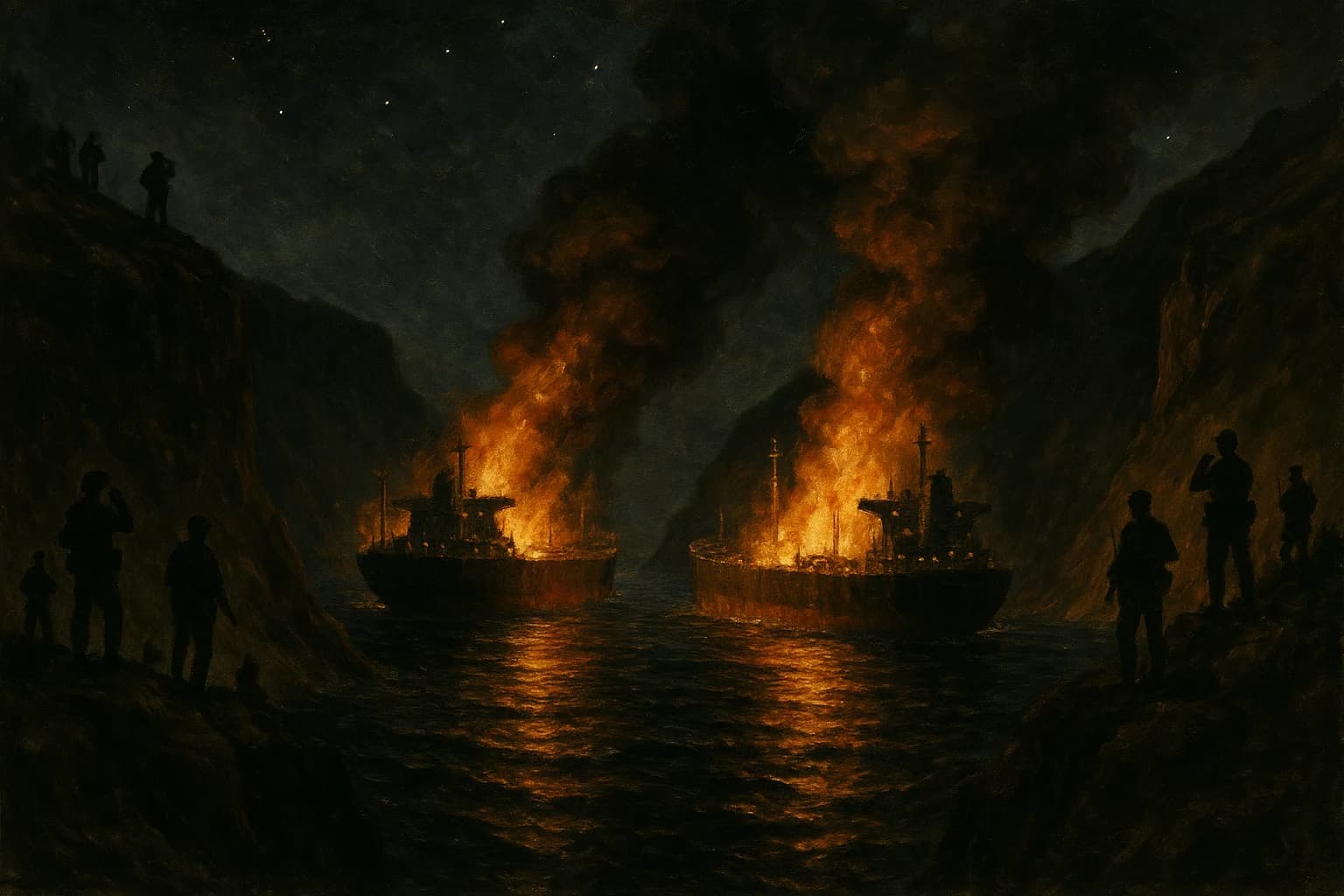
Iran struck tankers in the Strait of Hormuz this weekend. The attack tested a cease-fire brokered after months of escalating strikes between Iran, Israel, and their respective proxies. The cease-fire held, technically, for about as long as these things tend to hold.
Now the question is what comes next. The answer, historically, is not complicated.
The Strait
About 20% of the world's traded oil moves through the Strait of Hormuz. At its narrowest point it's 21 miles wide, with only two navigable channels, each two miles across. Iran sits on one side. Oman sits on the other. The United States Sixth Fleet moves through it on rotation.
The Strait is not a strategic chokepoint in the way that phrase usually implies — something that one party controls and another contests. It is a shared reality. Closing it punishes everyone, including Iran. Iran knows this. Every Iranian attack on tankers in the Strait has been calibrated to threaten without actually closing — to demonstrate capability and willingness without triggering the response that would follow a genuine blockade.
The problem with calibrated attacks is that calibration depends on the other side reading the signals correctly. And when the other side is a military and political machine that has been looking for a reason to move, a calibrated attack tends to get read as the reason.
The Script
Here is what happens next, in the order it happens:
The administration condemns the attacks and demands accountability. The military presents options. The president, having been presented options, selects the moderate one — enough to demonstrate credibility without triggering full escalation. The military executes the selected option. Iran responds proportionally, enough to demonstrate it was not deterred. Someone miscalculates the proportionality. The next round is less calibrated than the last.
This is not a prediction. It is a script. It has run before, in this same body of water, more than once. The tanker wars of the 1980s followed exactly this pattern, with exactly these actors in slightly different costumes. The result was a sustained low-grade conflict that served certain interests very well.
OK, Mr. President, the die is cast — so do what must be done.
That framing is the tell. "The die is cast" is the language of inevitability — the claim that the decision has already been made by events, that the president is merely executing what history requires. Julius Caesar said it crossing the Rubicon. Military briefers say it in every administration before every escalation. It is always presented as the final option after all others have been exhausted. The options are always presented in a way that makes the military response feel like the only remaining door.
The generals don't plan wars. They plan scenarios that make war feel inevitable. The distinction matters.
What It Costs
The Strait of Hormuz disruption will add $15–25 per barrel to oil prices within weeks. Gasoline prices will follow. The administration will blame Iran. The press will note that prices went up. The connection between military posture and energy markets — the fact that the premium priced into oil futures is a direct function of how close the US and Iran are to open conflict at any given moment — will be mentioned in the financial pages and not in the political coverage.
The industries with the most to gain from an elevated threat environment are defense contractors and oil majors, who benefit from both higher prices and the case for domestic production investment. These are the same industries that have spent the most lobbying the administrations that have maintained elevated US military presence in the Gulf for four decades.
This is not a conspiracy. It is an alignment of interests so durable and so well-funded that it produces the same outcome regardless of which party is in power. The generals who advise Democratic presidents give the same briefings they give Republican presidents. The options presented are the same options. The script runs the same way.
What "Must Be Done" Means
The phrase "do what must be done" is the tell, because nothing must be done.
The United States is not required to respond militarily to Iranian attacks on Omani-flagged tankers in the Strait of Hormuz. The cease-fire could be allowed to wobble without being abandoned. Diplomatic channels remain open even when they appear closed. The Omani government — which sits on the other side of the Strait from Iran and has more to lose from a genuine conflict than anyone — has historically served as a back-channel between Washington and Tehran precisely because it understands this.
"Must" is the word that launders a decision as a fact of nature. Every escalation in the Gulf has been presented as something that must happen, that could not have been otherwise, that the administration had no choice about. The historical record is that there were always choices, and the choices that were made served specific interests, and the interests that were served were not primarily the interests of the people who paid for the wars.
The die is cast. The generals are gathered. The script is running.
It does not follow that the ending is fixed.
Governance — the actual governance of actual systems, including military command authority and the structures that constrain how options get presented to presidents — is the mechanism that changes scripts. Not rhetorical governance. Not the performance of constraint. The actual wiring: audit trails on how decisions were made, accountability for how options were presented, reporting requirements that make the alignment of interests visible rather than assumed.
The generals gathered in their masses. The president will do what must be done.
The question is whether that sentence remains true next time, and the time after that, and the time when the miscalculation is one step too far.
— J.P. Howlett
Related: Nobody Profits from Peace — the arms trade, the incentive structure, and why peace is always more expensive than it looks.
Related: Tell Me I'm Wrong — governance as the mechanism that changes the default.
Related: Here We Are — the sequel. The ceasefire MOU is in pieces. The strikes resumed. Khamenei's funeral is still ongoing.
Sources
- Iran's Strikes on Ships in Strait of Hormuz Test Cease-Fire — The New York Times, July 7, 2026
- Strait of Hormuz: The World's Most Important Oil Chokepoint — U.S. Energy Information Administration
- The Tanker War, 1984–1988 — U.S. Naval History and Heritage Command
- U.S.-Iran Back-Channel Negotiations via Oman — The Atlantic