
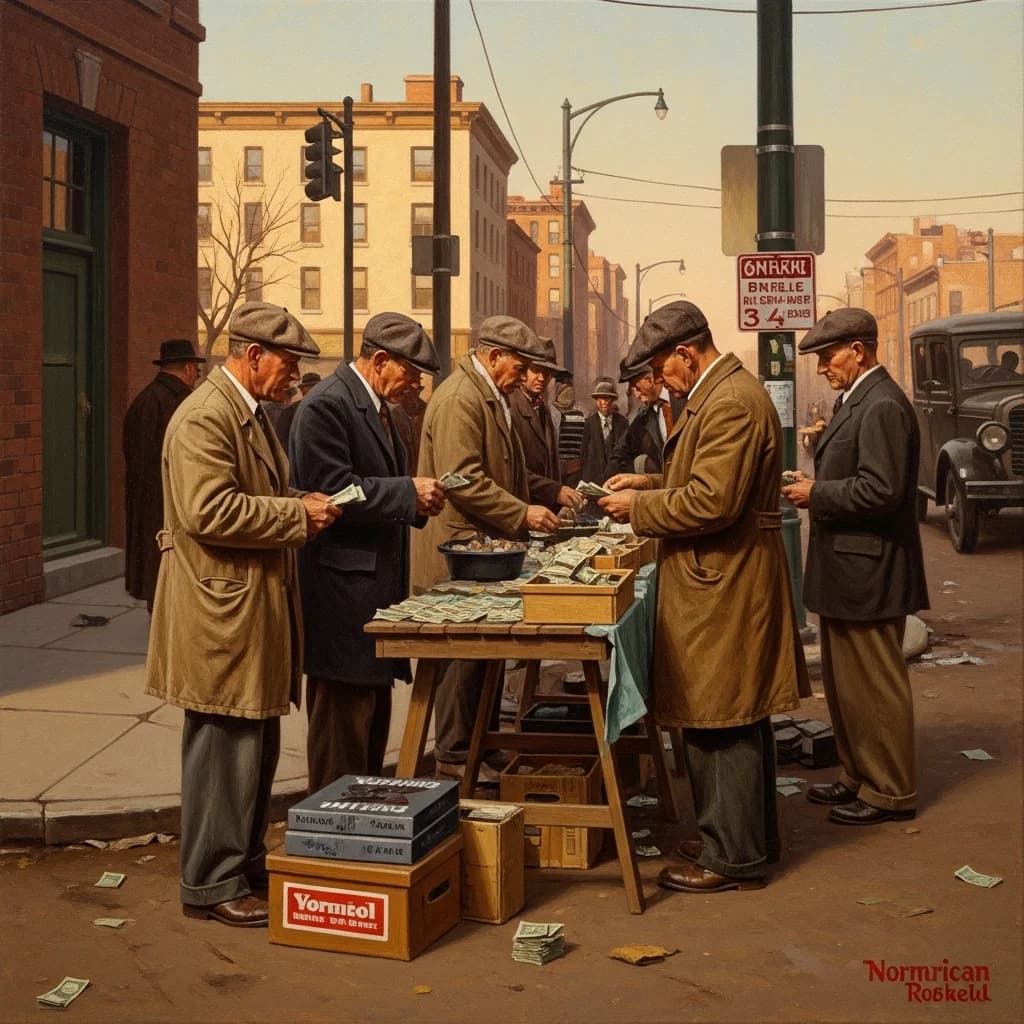
The formal economy is a quarterly report. The informal economy is a ticker that never stops.
Somewhere between $1.8 and $2.3 trillion in annual economic activity in the United States doesn't appear in GDP. It doesn't file with the IRS. It doesn't respond to Fed rate hikes with a board meeting or a press release. It just prices itself, continuously, based on what people actually need and what they're actually willing to pay.
This is the shadow economy — sometimes called the informal economy, the underground economy, or, when we want to be precise about what we're discussing, the vice economy. Drugs. Gambling. Cash-in-hand labor. Unlicensed lending. Sex work. Counterfeit goods. And the enormous grey zone between clearly illegal and merely unregulated: the contractor who takes cash, the babysitter paid without a 1099, the street vendor without a permit, the poker room operating under a thin legal theory.
This economy is not marginal. By serious estimates — primarily from Friedrich Schneider at Johannes Kepler University, whose shadow economy research spans forty years and over one hundred fifty countries — the informal economy comprises somewhere between 8 and 15 percent of American GDP. The IRS puts its annual tax gap — the difference between taxes legally owed and taxes actually paid — at approximately $600 billion per year, implying economic activity of several multiples of that figure operating outside official accounting. Globally, the IMF estimates the informal economy at around 32 percent of total GDP when developing economies are included.
This is not a rounding error. It is an economy larger than the GDP of most major nations, operating in plain sight, generating genuine price signals, and being almost entirely ignored by the macroeconomic models that central banks use to set monetary policy.
The premise of this series is straightforward: the vice economy is a leading indicator. Not because it's admirable — it isn't — but because it is epistemically honest in ways the formal economy cannot be. It tells you what people actually value, at the margin, with no institutional filters between the signal and the price. The corner has always known things that don't show up in the quarterly report.
The Double Economy
Every major economy runs two systems simultaneously. One is formal: measured, regulated, taxed, reported, and subject to the institutional inertia of bureaucracies, compliance cycles, and quarterly earnings calendars. The other is informal: cash, barter, undeclared, and perpetually adjusting to real conditions in real time.
These systems are not separate. They are deeply intertwined, constantly exchanging workers, capital, and price information. A construction worker may be formally employed Monday through Thursday and work a cash job on Friday. A restaurant may report some transactions and not others. A borrower who cannot get a bank loan may find informal credit through a network of personal relationships. The boundary between formal and informal is porous, and people cross it based on rational calculation of risk and reward.
The key economic property of the informal sector is precisely its informality: it has no regulatory delay between a price signal and a price adjustment. A formal grocery chain cannot immediately reprice its shelves in response to a supply shock. There are contracts to honor, category managers to consult, promotional schedules to maintain, and competitive dynamics to consider. A street market vendor can reprice a crate of tomatoes the moment she hears the trucks didn't arrive.
This is not a trivial advantage. In economics, the speed of price adjustment determines how quickly markets clear. Markets that adjust prices quickly to new information are, by definition, more informationally efficient — the price carries more current information. The informal economy, with no institutional friction between observation and price, is often a faster and more accurate barometer of underlying economic conditions than the formal economy's lagged, seasonally adjusted, politically interpreted data.
The Pawnshop as Economic Instrument
The most accessible and legible real-time indicator in the fringe economy is not illegal. It is sitting on your main street, behind a metal security grate.
Pawnshops are the informal economy's emergency credit market. A customer who pawns a possession is, almost by definition, someone who has exhausted every cheaper credit option available to them: the savings account, the family loan, the payday advance, the credit card cash advance. Pawnbroking is the end of the personal credit chain — you accept a fraction of an asset's market value in exchange for immediate cash, at an implicit interest rate that would be usurious in a formal lending context, because nothing cheaper is available.
The volume of pawn transactions is therefore a clean, real-time measure of how many people have hit the end of their personal credit chain. This measure has several properties that make it unusually useful as an economic indicator.
It is not subject to administrative lag. There is no quarterly filing, no seasonal adjustment, no benchmark revision. The pawn either happens or it doesn't. The data is what it is.
It is not subject to self-reporting bias. Unlike consumer confidence surveys, which ask people how they feel about the economy, pawnshop volume measures what people do under financial stress. Revealed preference is a better signal than stated preference, always.
It is geographically granular. Pawnshop activity can be tracked at the zip code level, giving a hyperlocal read on financial conditions that national data cannot provide. A spike in pawnshop volume in a specific community precedes the unemployment data for that area by months.
FirstCash Financial Services, the largest publicly traded pawnshop operator in the Americas, saw its revenue grow through the 2007–2009 financial crisis while the broader consumer sector was collapsing. Its growth trajectory is, in a meaningful sense, a chart of American financial fragility over time — and the chart was telling a story that the official unemployment and consumer confidence data had not yet caught up to.
There is also a qualitative signal that goes beyond volume. Pawnbrokers, who have no econometric models but years of market intuition, will tell you that the composition of pawned items shifts in a downturn in ways that are impossible to miss. Wedding rings. Watches that were anniversary presents. Items of sentimental value that only come off the finger or wrist when the electricity bill will not wait. This shift in composition happens well before the newspaper headlines. The pawnbroker knows.
What Lottery Tickets Reveal
State lottery data is publicly available, which makes it one of the few informal-economy signals that can be studied with real methodological rigor. And the pattern it reveals is consistent: lottery participation is inversely correlated with economic wellbeing.
This appears counterintuitive, because lottery tickets have negative expected value. Buying a lottery ticket is, by the math, irrational. But the mathematical framing misses what lottery tickets are actually for. They are not investments. They are the only credible mechanism available to a person with stagnant wages, rising debt, and no access to capital for generating a genuinely transformative change in economic status.
If your income is constrained by the wage ceiling of available employment, and your savings rate cannot compound fast enough to produce meaningful wealth, and your access to the credit that funds business formation is zero, then working harder and saving more produces a predictable outcome: marginally better, perpetually insufficient. The lottery ticket purchases something the formal economy cannot sell: a low-probability, transformative exit.
From this perspective, higher lottery participation during economic downturns is not irrational. It reflects an accurate assessment of the alternatives. People buy more lottery tickets when the formal-economy routes to financial transformation have narrowed.
Researchers studying lottery sales following plant closings, community economic shocks, and regional recessions consistently find meaningful increases in ticket purchases within one to two quarters of the shock. The lottery line is a leading indicator with a relatively clean signal, because it is not mediated by institutional inertia. When the factory closes on a Thursday, the line at the lottery retailer is longer by Friday.
Why Unregulated Markets Tell the Truth
The deeper argument for the vice economy as economic signal rests on a fundamental property of price: it carries information only to the degree that it is allowed to adjust freely to underlying conditions.
Regulated markets have price floors, price ceilings, administered rates, and political constraints. They have contracts that lock in prices for months or years. They have regulatory disclosure requirements that create delays between economic reality and public information. They have large institutional participants who are skilled at managing market perceptions.
The informal economy has none of these features. When demand rises, the price rises. When supply is constrained, quality falls while the nominal price holds — which is itself a price signal. When people run out of money, they show up at pawnshops and lottery counters in ways that official sentiment surveys cannot capture.
This is not an argument that informal market prices are perfect. They are noisy. They are disrupted by law enforcement cycles, supply shocks unrelated to economic conditions, and the violence and information asymmetry that characterize illegal markets. But they are honest in a way that administered prices, seasonally adjusted indices, and formally reported economic data cannot always be.
The formal economy is a picture of the economy as institutions prefer to describe it. The informal economy is the economy as it actually is.
The Specific Signals Worth Watching
For anyone trying to read informal-economy signals as economic indicators, the most informative categories are:
Pawnshop volume and composition. Rising volume is stress. The shift in composition — from electronics and instruments toward jewelry and irreplaceable items — is severe stress. This is geographically trackable and temporally leading.
Lottery ticket sales. Rising sales, particularly in working-class communities, signal economic hopelessness before it appears in unemployment data. The relationship is not linear — emergency cash (stimulus checks, for example) can temporarily spike lottery sales — but the underlying trend is meaningful.
Payday loan and check-cashing volume. The high-cost short-term credit market is, like pawnbroking, a revealed-preference measure of people at the end of their formal credit options. Rising volume signals stress. Rising average loan sizes signal deepening stress.
Day labor market activity. The informal labor market — cash-day-labor, gig-work-adjacent, under-the-table employment — expands when formal employment contracts. Tracking this is harder without formal data, but regional reports from day labor centers and anecdotal labor market reporting can be informative.
Vice market pricing. Drug prices, gambling odds, sex work rates — these are harder to track, messier to interpret, and politically uncomfortable to cite. But they are among the most sensitive and honest price signals in the economy, because the vice economy has neither the institutional capacity to smooth them nor the political incentive to manage the appearance. More on this in the articles that follow.
The Uncomfortable Usefulness
There is a reflexive discomfort with the idea of using illegal or morally contested market data as economic indicators. This discomfort is understandable but should not translate into analytical blindness.
Economists already use the prices of speculative assets — meme stocks, cryptocurrency, futures contracts on things no one actually needs — as indicators of sentiment, risk appetite, and monetary conditions, despite the fact that these prices are driven partly by manipulation, misinformation, and pure speculation. Using those prices as data while refusing to use vice economy prices is inconsistent. Both are noisy. Both are informative. The noise in vice economy data comes from enforcement disruption and illegality; the noise in financial market data comes from algorithmic trading, information asymmetry, and manipulation. Neither source is pristine.
The formal economy tells a story about the economy that its institutions have an interest in telling. The informal economy tells a story about what people actually do when the formal story breaks down.
For commercial lending — which ultimately serves businesses and borrowers who live in the real economy, not the quarterly report — the vice economy's story is often more relevant than the version the headline indices provide. The borrowers seeking short-term capital from alternative lenders are, in many cases, the same people whose economic conditions appear first in informal economy data. The stress they're experiencing shows up on the corner before it shows up in the report.
FundScout connects businesses with vetted commercial lenders through a transparent marketplace — because real economic conditions matter more than the official story. This is the first in a series on the vice economy as financial signal.
Sources
- Friedrich Schneider, Andreas Buehn, and Claudio Montenegro, "Shadow Economies All Over the World: New Estimates for 162 Countries from 1999 to 2007", World Bank Policy Research Working Paper 5356 (2010) — US informal economy estimated at 8–15% of GDP
- Leandro Medina and Friedrich Schneider, "Shadow Economies Around the World", IMF Working Paper WP/18/17 (2018) — global informal economy approximately 32% of GDP in developing countries; 18% in advanced economies
- IRS annual tax gap (~$600 billion): IRS, Tax Gap Estimates for Tax Years 2014–2016 (2019) — irs.gov
- FirstCash Financial Services revenue growth during 2007–2009 financial crisis: SEC filings, NASDAQ financial data; pawnshop revenue counter-cyclical to broader consumer sector
- Emily Haisley, Romel Mostafa, and George Loewenstein, "Subjective Relative Income and Lottery Ticket Purchases", Journal of Behavioral Decision Making, Vol. 21 (2008) — lottery participation inversely correlated with perceived economic wellbeing; plant closing studies show measurable ticket purchase increases within one to two quarters
- Payday lending volume as credit stress indicator: Consumer Financial Protection Bureau, Payday Loans and Deposit Advance Products (April 2013) — consumerfinance.gov