
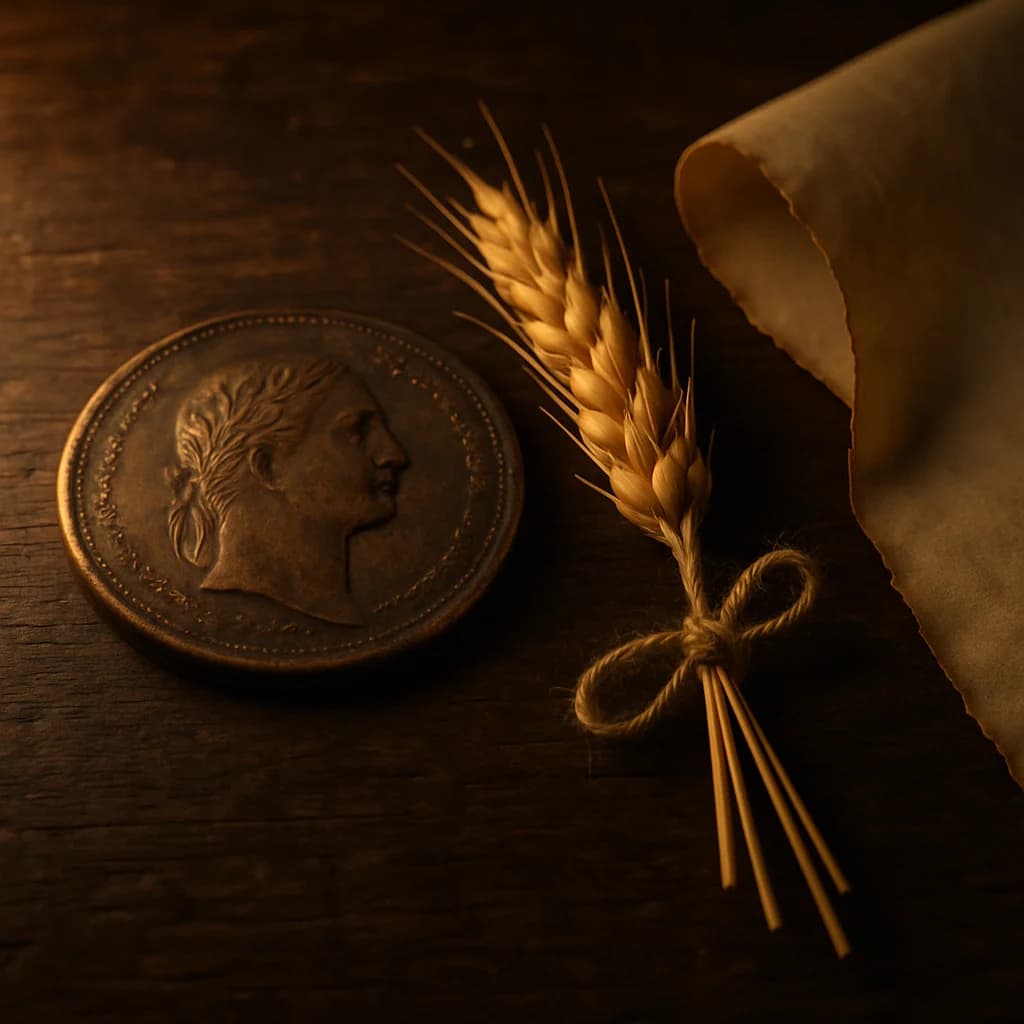
When a carpenter shows up to measure a room, she brings a tape measure. The tape measure does not change length depending on who made it, which government issued it, or what the mortgage rate was that quarter. A meter is a meter. A foot is a foot. Measurement requires a fixed standard, or it isn't measurement — it's estimation, opinion, approximation.
Money has always pretended to be a measure of value. Under central banking, that pretense has become almost too absurd to maintain with a straight face. The unit of measure contracts and expands at the discretion of a committee that meets eight times per year to decide what the economy needs. Calling this a "measure" of value is like letting a carpenter's guild vote on how long a foot is every six weeks and then insisting that construction is getting more precise.
Adam Smith understood this in 1776. Some English landlords understood it before he was born. The interesting question is why we keep pretending otherwise.
Smith on the Problem With Money
The Wealth of Nations opens with labor — the division of it, the productivity gains it produces, the pin factory that becomes the emblem of industrial organization. But the deeper and more uncomfortable argument Smith makes is about value itself.
In Book I, Chapter V — "Of the Real and Nominal Price of Commodities" — Smith drives a wedge between what he calls the real price of things and their nominal price. The real price of anything, Smith argues, is the labor required to acquire it: the toil, the time, the human effort exchanged. The nominal price is what money says things cost. These are not the same thing, and confusing them is, for Smith, the central error of economic thinking.
"Labour, therefore, it appears evidently, is the only universal, as well as the only accurate measure of value, or the only standard by which we can compare the values of different commodities at all times and at all places."
Money, Smith argues, is useful for exchanging value — but not for measuring it. Why? Because money itself changes. The discovery of rich silver mines in the Americas in the sixteenth and seventeenth centuries flooded Europe with currency and drove prices upward across the continent. Nothing about the actual productive value of labor, land, or goods changed. The measuring stick shrank.
This was the context in which Smith observed a practice among English and Scottish landlords that he found economically sensible: fixing rents not in money, but in corn.
Corn Rents and the English Wisdom
In medieval and early modern England, long leases on agricultural land frequently specified rent in kind — a fixed quantity of grain, typically wheat or corn — rather than in money. Or they specified a money rent pegged to the prevailing price of corn. This was not agricultural nostalgia or inefficiency. It was a hedge against exactly the problem Smith identified.
A landlord who fixed a 21-year lease at £40 per year in 1600 would find himself, by 1621, receiving what amounted to far less real value — not because the land produced less, but because the influx of Spanish silver had eroded the purchasing power of the pound. The land was the same land. The labor required to farm it was the same labor. The monetary expression of its value had been silently reduced by forces entirely outside the landlord's control.
Smith wrote admiringly of this arrangement in Book I, Chapter XI:
"If through the course of a long lease the tenant have occasion to sell his labour...he can always buy with it a quantity of corn nearly equal to what it could have purchased at the time he first set out."
The corn-rent solved a real problem: it anchored the exchange in something with relatively stable real value — the labor of producing a bushel of wheat — rather than something whose value was hostage to the political and monetary decisions of distant sovereigns. Over the centuries since, grain yields per acre have changed. Technology has changed. But the basic relationship between human labor and the grain it produces has remained far more stable than any currency in circulation.
Smith considered corn the best practical long-run measure of value precisely because it was tethered to something real: the land's productive capacity and the human work required to extract it. Silver and gold were already arbitrary — their value set by the accidents of discovery and supply. Paper money, had Smith lived long enough to see the full flowering of it, would have struck him as multiple removes further from any real foundation.
The Share Certificate Theory of Fiat Currency
Here is a frame that clarifies what fiat currency actually is.
A share of stock is a proportional claim on the assets, earnings, and future cash flows of a company. If a company has issued one million shares and you hold one share, you hold one one-millionth of the company's value. If the board of directors votes to issue another million shares without adding any assets or earnings, your share is now worth one two-millionth of the same underlying value. This is dilution. It is not illegal. It happens all the time. But it is a transfer of value from existing shareholders to whoever receives the new shares.
A unit of fiat currency is structurally identical: a proportional claim on the productive output of a national economy. The dollar does not represent a fixed quantity of gold, silver, or anything physical — it is a claim on the real goods and services the American economy produces. If the total productive output of the United States is $25 trillion and there are $25 trillion in circulation, each dollar is a claim on $1 of real output. If the Federal Reserve creates $5 trillion in new currency without any corresponding increase in output — and between 2020 and 2022, the Fed added approximately $4.8 trillion to its balance sheet — each dollar is now a claim on $0.83 of the same output.
The purchasing power loss was not coincidental. It was arithmetic.
This is not a fringe interpretation. It is the mechanism that virtually all economists acknowledge as the basis for inflation — too much money chasing the same goods. The disagreement is over whether that mechanism is a bug or a feature, who controls it, and who benefits. On those questions, the economic profession has been far less candid.
The Central Bank and the Cantillon Effect
Richard Cantillon was an Irish-French banker and economist who died in 1734 — two years before Adam Smith entered Glasgow University as a student. His Essai sur la Nature du Commerce en Général (1730) is among the most important economic texts written, and among the least celebrated, perhaps because its central insight is too uncomfortable for the institutions that would later come to dominate monetary policy.
Cantillon's observation, now called the Cantillon Effect, is this: new money does not distribute itself evenly or simultaneously through an economy. It enters through specific points — whoever receives it first. Those first recipients spend it at existing prices, before prices have adjusted upward to reflect the expanded money supply. The real economic gain accrues to them. By the time the new money has worked through the system and prices have risen, the people at the end of the distribution chain — wage earners, savers, holders of fixed incomes — find themselves with the same or fewer nominal dollars but facing higher prices. Their purchasing power has been transferred, without their consent or awareness, to whoever stood at the front of the queue.
In the eighteenth century, Cantillon was describing what happened when kings debased coinage or when new silver arrived from colonial mines. The metal entered first through the nobility, the merchants, the trade houses. Farmers and laborers at the economic periphery felt the price effects last.
In the twenty-first century, the queue begins at the Federal Reserve's primary dealers — the eighteen large financial institutions authorized to transact directly with the Fed. When the Fed creates new money to purchase assets through quantitative easing, it purchases those assets from primary dealers at prevailing prices. The dealers hold assets that appreciate as money flows into the system. Asset prices rise. The S&P 500 rises. Real estate prices rise. By the time ordinary inflation registers in consumer prices, the financial sector has already extracted its gain from the expansion.
This is not conspiracy. It is architecture. The central banking system is designed to inject money through the financial system first. That is by construction what it does.
The Hustle: Seigniorage and the Tax You Didn't Vote For
Seigniorage is the profit that accrues to the issuer of currency from the difference between the cost of producing money and its face value.
In the era of gold and silver coinage, this was a minor and visible phenomenon: a coin containing 90% silver was minted and declared legal tender at 100% face value, and the crown kept the difference. Obvious, bounded, and at least in principle visible to the people being charged.
Under modern central banking, seigniorage operates at a different scale and with far greater obscurity.
The Federal Reserve creates dollars at essentially zero cost — electronic ledger entries, or in the case of physical currency, paper and ink at roughly 5 to 15 cents per note. A hundred-dollar bill costs about 15 cents to produce. The difference between production cost and face value — $99.85 — is seigniorage. In 2022, the Fed remitted approximately $76 billion in seigniorage profit to the U.S. Treasury. This is revenue generated by a government body without a tax bill, without a vote, without public deliberation.
But the deeper form of seigniorage is the inflation tax.
When a government runs a deficit, it has several options: raise taxes, issue bonds, or have the central bank create money to purchase those bonds (the process politely called "monetizing the debt"). The third option is seigniorage in its modern form. New money is created. The government spends that money at current prices. Prices subsequently rise. The population as a whole — every holder of dollars — finds their savings and purchasing power diminished by the resulting inflation. The wealth extracted by this process was transferred to the government when the new money was spent.
It is a tax on dollar-holders, levied without legislation, obscured by the time lag between money creation and price adjustment, and administered by an institution that describes its mandate in terms of "price stability" and "full employment."
Price stability. The Fed has existed since 1913. The purchasing power of the dollar has declined approximately 97% since then. A dollar in 1913 purchased what roughly $32 purchases in 2024. If this is price stability, it is stability the way a slow leak is waterproofness — technically defensible over short intervals, catastrophic in aggregate.
The Bank of England and the Original Arrangement
The Bank of England was founded in 1694. The arrangement was explicit and remarkable: a group of merchants loaned William III £1.2 million to finance his wars against France. In exchange, they received a royal charter allowing them to incorporate as a bank and to issue banknotes equal to the full amount of the loan.
Read that again. The merchants loaned the government £1.2 million. The government gave them permission to lend out an additional £1.2 million they didn't have. At inception, the Bank of England's fundamental power was the right to create claims on wealth without the underlying wealth existing.
The note-issuing privilege — the right to issue paper claims in excess of physical reserves — is the core of what central banking is. It is, in the literal sense of the word, creation of money from nothing. The difference between counterfeiting and central banking is legal authorization. The mechanism is identical.
What the merchants of 1694 understood, and what subsequent centuries have confirmed, is that controlling the issuance of money is the most durable form of economic power that exists. It does not require producing goods. It does not require winning in competition. It requires only the legal authority to define what money is and the exclusive right to create it.
The governments that charter central banks receive financing. The banks that operate within the system receive liquidity on favorable terms. The financial sector generally receives the Cantillon-effect advantage of being first in line when new money is issued. Everyone else receives inflation and is told it is a natural economic phenomenon.
What Corn Knew That Dollars Don't
Return to the English landlord and his corn rent.
The corn knows things the dollar doesn't. It knows that a bushel of wheat requires a certain amount of land, a certain growing season, a certain quantity of human labor to plant, tend, and harvest. These constraints are real. They exist outside of any political decision. A committee cannot vote to make wheat grow faster, and a central bank cannot add another growing season to the calendar.
When rent is fixed to corn, the landlord's income reflects the real productive capacity of the land and the real labor required to work it. The anchor is external to the monetary system. Price signals, even when they pass through money on the way to the ledger, trace back to something no institution controls.
When everything is denominated in fiat currency — wages, savings, rents, debts, pensions — the anchor has been removed. What remains is a system of claims denominated in units whose quantity and therefore value is determined by a committee. The measuring stick is the committee's. The measurements are the committee's. The population uses the measurements without being told how often the stick's length is revised, or in whose interest.
This is why Adam Smith preferred corn. Not sentimentality for agriculture. Not ignorance of financial instruments. He preferred corn because corn is honest. It is tethered to the real. Whoever holds it holds something that required real labor to produce and retains real value independent of what any sovereign decides.
Why This Matters for Borrowers
The gap between understanding money as a real resource and understanding it as a managed political instrument is not academic. It changes how you calculate the cost of debt.
When you borrow money and agree to repay it with interest, the real cost of that debt is the stated interest rate minus the inflation rate. At 6% interest and 3% inflation, the lender earns 3% real return and you pay 3% real cost. At 6% interest and 6% inflation, you repay the debt in dollars worth 6% less per year — the real cost of borrowing is approximately zero. At 6% interest and 8% inflation, you are effectively being paid to borrow.
The Federal Reserve's management of inflation directly shapes the real cost of every commercial loan, mortgage, and credit facility in the country — not through the borrower's choices, but through decisions made in closed meetings by unelected officials applying economic models that have been consistently, demonstrably wrong about inflation in ways that cost ordinary savers and debtors dearly.
A borrower who understands that fiat currency is a dilutable claim on a national economy, that the central bank controls that dilution, and that the Cantillon effect ensures the financial sector captures the gain while the cost distributes broadly — that borrower makes different decisions. They account for real rates, not nominal ones. They think about the duration of debt in inflationary periods. They understand why lenders price fixed-rate long-term credit so carefully, and what it means when they price it carelessly.
The English landlord who fixed rent to corn was not being old-fashioned. He was being precise about what he was actually owed and how to ensure he received it. In a world of managed currencies, that precision is harder to achieve — but the underlying instinct was correct, and the problem he was solving has not gone away.
It has gotten considerably larger.
Sources
- Adam Smith, An Inquiry into the Nature and Causes of the Wealth of Nations, Book I, Chapter V: "Of the Real and Nominal Price of Commodities"; Book I, Chapter XI (1776) — labor as measure of value; corn rents; Spanish silver influx
- Richard Cantillon, Essai sur la Nature du Commerce en Général (ca. 1730; published 1755; English trans. Henry Higgs, 1931) — Cantillon Effect on the distribution of newly created money
- Federal Reserve balance sheet expansion 2020–2022 (~$4.8 trillion added): Federal Reserve H.4.1 Statistical Release — federalreserve.gov
- Dollar purchasing power decline (~97% since 1913): U.S. Bureau of Labor Statistics CPI-U historical series — BLS Inflation Calculator; Federal Reserve Bank of Minneapolis
- Federal Reserve seigniorage remittances ($76 billion to Treasury in 2022): Federal Reserve, Annual Report 2022 — federalreserve.gov
- $100 bill production cost (~15 cents): U.S. Bureau of Engraving and Printing — moneyfactory.gov
- Bank of England founding (1694): J.H. Clapham, The Bank of England: A History (Cambridge University Press, 1944); £1.2 million loaned to William III in exchange for note-issuing charter
- Federal Reserve primary dealers (approximately 24 institutions): Federal Reserve Bank of New York — newyorkfed.org
- Earl Hamilton, American Treasure and the Price Revolution in Spain, 1501–1650 (Harvard University Press, 1934) — Spanish silver influx and European price inflation in the 16th–17th centuries