
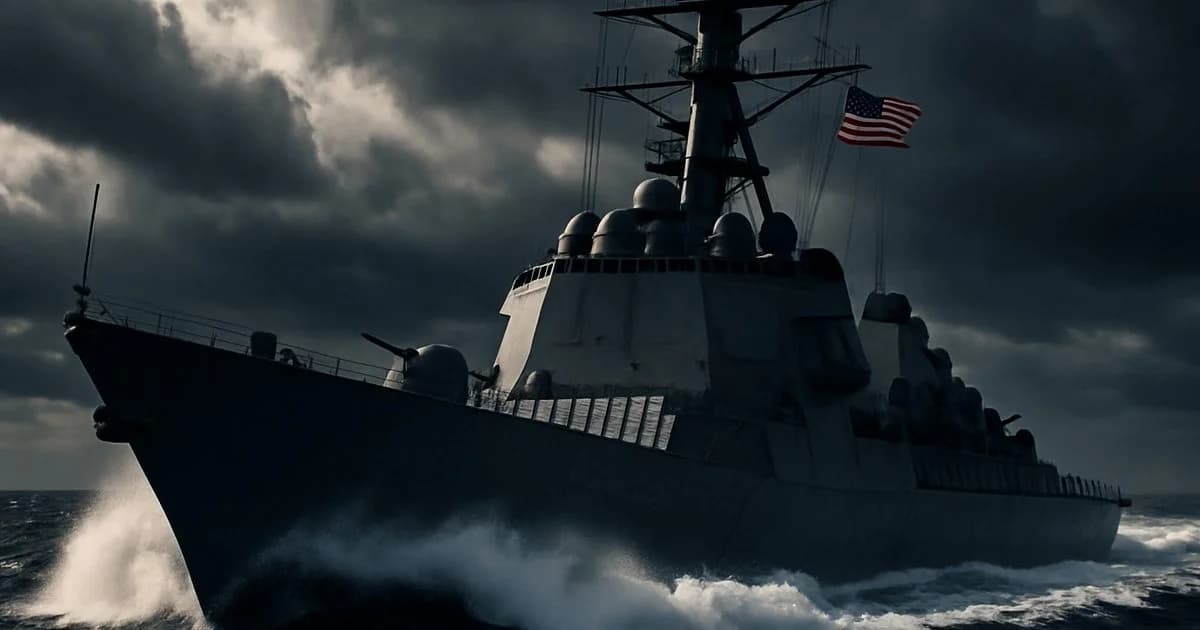
When President Trump unveiled the Trump-class battleship at Mar-a-Lago in December 2025, most of the coverage focused on the hardware: the railguns, the hypersonic missiles, the sheer audacity of building a 35,000-ton warship in an era of precision-guided munitions. That framing missed the point.
The USS Defiant (BBG-1) isn't primarily a weapon. It's an industrial policy wrapped in a hull.
The Ship That Rewrites Naval Doctrine
For context: the battleship didn't die because it was outgunned. It died because it was outranged. The 16-inch guns aboard an Iowa-class could reach 24 miles. A carrier's aircraft could strike from 500 miles. In a modern engagement, you could sink a battleship before its crew knew a carrier was in the same ocean.
What the Trump-class revives isn't the gun — it's the hull. A 35,000-ton platform (roughly three times the displacement of an Arleigh Burke destroyer) solves a problem that has been quietly worrying naval planners for a decade: the Vertical Launch System capacity crisis.
Modern destroyers are missile-limited. An Arleigh Burke carries 96 VLS cells — and once those are expended, the ship is effectively a very expensive coast guard cutter until it returns to port. The Defiant is designed with 128 VLS cells plus a 12-cell hypersonic strike system, megawatt-class lasers, and a railgun — all powered by an onboard nuclear reactor that makes conventional energy weapons viable at sea for the first time.
More importantly, the ship is designed to act as a mothership for unmanned systems: a command-and-control hub that can quarterback swarms of aerial, surface, and underwater drones. The "battleship" label is a rhetorical choice; the actual concept is a floating missile truck and autonomous-systems quarterback.
Martial Keynesianism: The Real Thesis
None of this is why the Golden Fleet matters for commercial borrowers. This is:
The Navy's FY2027 shipbuilding plan calls for $68.5 billion — a 57% increase over the prior year's request. Realizing the full Golden Fleet of 20–25 Trump-class hulls, plus supporting frigates and unmanned platforms, will require growing the American shipbuilding workforce by 250,000 workers. Hanwha's Philadelphia Navy Yard alone is planning to hire up to 10,000 workers and quadruple its production capacity.
This is what economists call demand-side industrial policy — or, more candidly, Keynesian spending with a defense justification. The administration is deliberately using procurement mandates to force capital back into the domestic manufacturing base.
The logic is straightforward: if you mandate that every weld on a 35,000-ton nuclear-powered warship be done by American workers, in American yards, with American steel — you don't just build a ship. You build a generation of shipfitters, machinists, and high-precision welders. You reopen the zinc mines in places like Hamburg, New Jersey that current global pricing made unviable. You create a decade-long order book that gives manufacturers the confidence to buy equipment, expand facilities, and hire.
"A battleship is a terrible weapon but a magnificent factory."
This distinction matters. Trickle-down economics assumed that capital concentrated at the top would eventually reach workers. The Golden Fleet model is a forced reversal: the government directs capital to the bottom of the industrial stack — the fabricators, the sub-suppliers, the specialty materials providers — and the economic activity works its way upward.
Whether you find that economically sound or politically suspect, the numbers are real. $68.5 billion in shipbuilding procurement doesn't stay in a defense contractor's headquarters. It flows to steel mills, electrical contractors, pipe fitters, logistics operators, and thousands of small manufacturing businesses that will need equipment loans, working capital lines, and expansion financing to meet the demand.

The Hanwha Philadelphia Navy Yard is planning to quadruple its workforce to 10,000 workers. The surrounding supply chain — fabricators, specialty manufacturers, logistics operators — represents the real economic footprint of the Golden Fleet.
Historical Echoes and Modern Risks
The use of state-directed infrastructure spending to revive a hollowed-out industrial base isn't new. The Eisenhower Interstate System. The Tennessee Valley Authority. Further back, the post-WWI German rearmament programs and Autobahn construction of the 1930s demonstrated — in a dark context — that coordinated state procurement can rebuild industrial capacity with remarkable speed when the political will exists.
The risk is also well-established. Programs of this scale require sustained political commitment across administrations, and they tend to generate the kind of concentrated contractor relationships that make them resistant to cuts even when effectiveness is questionable. The Congressional Budget Office has already flagged that Hanwha Philadelphia has never built a defense vessel, making the lead ship's 2028 construction start optimistic.
Critics also note the fundamental targeting problem: a 35,000-ton nuclear warship is an expensive single point of failure in an era of $200,000 anti-ship missiles. The same $17 billion could fund roughly 85,000 long-range strike missiles. Whether the strategic calculus works out depends on assumptions about future warfare that serious analysts disagree about.
What's not in dispute: the spending is happening.
What This Means for Commercial Borrowers
The Golden Fleet's economic footprint extends well beyond shipyards. The Navy has explicitly committed to distributed manufacturing — spreading procurement across suppliers in every state rather than concentrating it at a handful of prime contractors. That creates commercial lending demand across a wide range of industries:
- Equipment financing for small manufacturers upgrading to meet Navy spec tolerances
- Working capital lines for sub-tier suppliers managing the gap between contract award and first payment
- Commercial real estate for facility expansion near the shipyards and logistics hubs
- MCA and short-term lending for service businesses in communities seeing rapid job growth
The 250,000-worker expansion is also, implicitly, a small business formation engine. Skilled tradespeople who train in shipbuilding often start their own specialty contracting shops. That first five years — between hiring surge and business maturity — is precisely the window where alternative commercial lending fills the gap that traditional banks won't.
The Next Carrier Won't Be Naval
One thread from the military-strategy community worth watching: the USS Defiant is likely one of the last purely maritime capital ships, not the first of a new era. The Defiant's nuclear power plant and laser communication systems are explicitly designed to integrate with Low Earth Orbit satellite networks — it functions as a terrestrial anchor for an orbital defense architecture.
The Department of War (reconstituted in name by Executive Order 14347 in September 2025) has made clear in planning documents that the 2030s vision includes modular LEO platforms capable of launching drone swarms and precision kinetic weapons from orbit. The "carrier" of 2040 may not need an ocean at all.
For now, that's a thought experiment. What's not hypothetical is the $68.5 billion procurement surge, the 250,000 jobs, and the distributed supply chain that will reach into manufacturing communities across every region of the country.
If your business is in the manufacturing, logistics, or skilled trades sectors and you're looking for capital to position for this cycle, FundScout connects you with vetted commercial lenders — without selling your contact information or triggering a spam spiral. The window between a contract announcement and the moment credit terms tighten is always shorter than it looks.
Sources
- Navy FY2027 shipbuilding budget ($68.5 billion request): U.S. Department of Defense, FY2027 President's Budget Request — comptroller.defense.gov
- Hanwha Ocean Philadelphia Navy Yard — company announcement of workforce expansion; philaport.com and Hanwha Ocean press releases
- Arleigh Burke-class destroyer specifications — 96 Vertical Launch System (VLS) cells; navy.mil
- Historical precedents for defense-driven industrial policy — Eisenhower Federal-Aid Highway Act (1956), Pub. L. 84-627; Tennessee Valley Authority Act (1933); for German rearmament context see Adam Tooze, The Wages of Destruction: The Making and Breaking of the Nazi Economy (2006)
- Congressional Budget Office shipbuilding analysis — CBO, An Analysis of the Navy's Fiscal Year 2024 Shipbuilding Plan (October 2023) — cbo.gov
- Executive Order 14347 (September 2025) — reconstitution of the Department of War designation; federalregister.gov