
Richard Cantillon was murdered in 1734. His house in London was set on fire — his cook, whom he had recently dismissed, was the primary suspect, though the circumstances were sufficiently murky that historians still argue about it. Whatever happened, Cantillon died at approximately fifty-four years of age, a wealthy banker and economist whose manuscript had been circulating privately for years but would not be published for another two decades.
The manuscript, Essai sur la Nature du Commerce en Général, is now recognized as one of the most important works in the history of economics. It introduced the concept of the entrepreneur as a distinct economic actor. It developed an early version of the circular flow of income. And it contained an observation about the mechanics of monetary expansion that three centuries of subsequent economic history have validated so comprehensively that the observation now carries Cantillon's name.
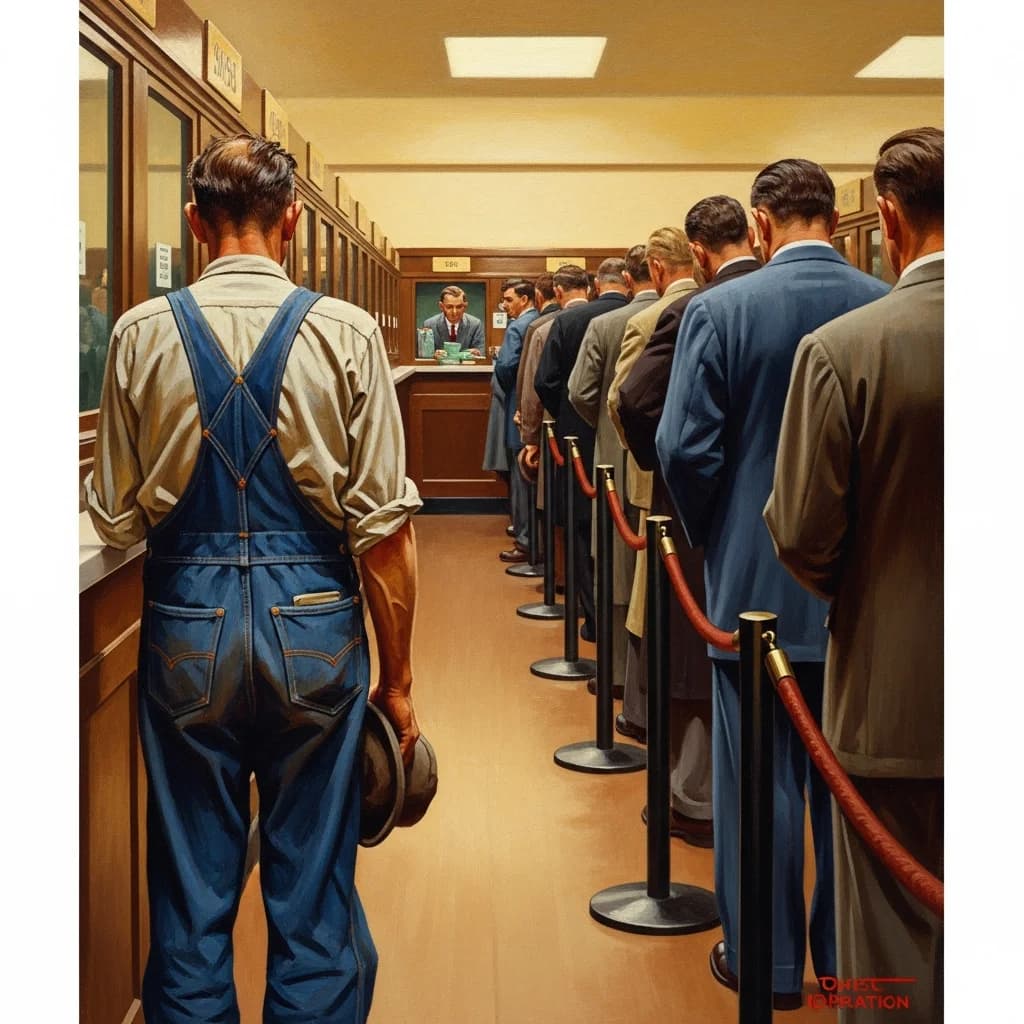
The Cantillon effect: newly created money does not affect all prices simultaneously and equally. It flows through the economy in a sequence determined by who receives it first. Those who receive it first benefit — they can buy at old prices before the new money has caused prices to rise. Those who receive it last are disadvantaged — they face higher prices before any corresponding increase in their own income has arrived. The money, in other words, redistributes real purchasing power as it moves. Early recipients gain. Late recipients lose.
This mechanism, which Cantillon described in the context of gold discoveries and sovereign mint operations, applies with equal force to modern central bank monetary policy. And its terminal stage — the last recipients, the furthest from the source — is the informal economy.
The vice economy gets the inflation without the income. It shows the strain before the headline data does. And this is why it is, counterintuitively, a better real-time sensor of monetary conditions than most official indices.
The Modern Cantillon Chain
The Federal Reserve, in a quantitative easing program, purchases assets — Treasury securities, mortgage-backed securities — from primary dealers. Primary dealers are the large financial institutions authorized to transact directly with the New York Fed: JPMorgan, Goldman Sachs, Bank of America, and approximately twenty others.
The newly created reserves flow first to these institutions. They are the first recipients in the modern Cantillon chain.
What do primary dealers do with excess reserves? They invest in financial assets. Equity markets rise as institutions deploy capital. Bond yields fall as demand for fixed income increases. Real estate values rise as cheap financing makes asset ownership more attractive. Those who hold financial assets — shareholders, bondholders, property owners — see the real value of their holdings increase. This is the first-recipient benefit: asset price inflation that accrues to those who own assets before the money has worked its way into consumer prices.
The second stage: with cheap wholesale funding available and balance sheets flush, banks lend to large creditworthy corporations at historically low rates. These corporations refinance existing debt at lower rates, reducing their cost of capital. They engage in stock buybacks, which further inflates equity prices. They fund capital expenditures. The stock market continues to appreciate. Executive compensation, typically equity-linked, rises accordingly.
The third stage, with significant lag: corporate investment eventually creates employment, and wages in the formal sector begin to rise as labor markets tighten. Consumer goods prices begin to increase as money works its way into circulation. Inflation, which appeared first in asset prices (where it is measured separately, or not at all, in official statistics), now appears in consumer prices, where the CPI captures it.
The fourth stage: the informal economy. The day laborer, the street vendor, the informal-economy participant, the cash-wage worker in the unregulated margin of the labor market. These individuals do not own the financial assets that appreciated in stage one. They did not benefit from the low-rate refinancing in stage two. They did not receive the wage increases in stage three — or received them last and least, after the productivity gains from the monetary expansion had already been captured by capital.
What they receive, eventually, is the downstream: higher food prices, higher rent, higher transportation costs. The inflation that was first an asset-price phenomenon, then a consumer-price phenomenon, has now reached the portion of the economy most exposed to price increases and least cushioned against them. The Cantillon effect has completed its circuit. The people at the bottom got the inflation and missed the income.
Why This Makes the Street a Leading Indicator
The popular understanding of the Cantillon effect focuses on its distributional injustice: it explains why monetary expansion systematically benefits the wealthy (who hold assets) at the expense of the poor (who don't). This is correct, and it is important. But there is a second-order implication that gets less attention: the sequence of the effect makes the informal economy a leading indicator of monetary policy failure.
Because the informal economy receives inflation without the preceding income benefits, it experiences the stress of monetary expansion before the formal economy's official statistics have captured it. When the Fed has been running expansionary policy for long enough that inflation is beginning to compress real wages in the formal sector, the informal economy has often been feeling that compression for quarters already.
The stress responses are measurable. More people enter informal credit markets — payday lending, pawnbroking, informal personal loans — to bridge the gap between stagnant informal wages and rising prices. More people enter informal labor markets, taking on additional cash work to supplement formal income that is not keeping pace. The vice economy — already the sector most disconnected from formal income gains — shows the results of this pressure earlier and more acutely than any officially measured sector.
There is a specific implication for downturns. When formal economic activity contracts, the informal economy expands as workers and businesses seek income and customers outside the formal channel. People who are laid off from formal employment enter the cash labor market. Businesses under financial pressure sell inventory informally, or shift to cash transactions to preserve liquidity. This informal-economy expansion occurs during periods when official employment statistics are showing rising unemployment — the two events are simultaneous, because they are the same people moving between sectors.
The informal economy does not show up in the unemployment rate, which counts only those seeking formal employment. The people who have moved into cash-economy work are neither employed (in official terms) nor unemployed (in official terms). They are invisible to the model. But they are participating in an economy that is visible, if you know where to look.
Venezuela: The Cantillon Chain at Its Extreme
The clearest modern demonstration of the Cantillon effect running to completion — and of the informal economy pricing the truth years before the official statistics admitted it — is Venezuela during the Maduro government's period of currency collapse.
The Venezuelan government maintained official bolivar exchange rates throughout the 2013–2019 period that bore almost no relationship to the actual purchasing power of the currency. The official rate, defended by capital controls and enforced by law, suggested a stable currency. The black market rate — the informal economy's price for a dollar — told a different story. By 2016, the gap between the official rate and the parallel market rate had grown to two orders of magnitude. By 2018, the International Monetary Fund estimated Venezuelan inflation at over one million percent annually.
The informal economy had been pricing this reality correctly, in real time, for years before the official statistics acknowledged it. Black market currency traders, operating outside the formal system and therefore outside the political pressure to maintain the fiction of a stable exchange rate, were accurate economic sensors embedded in a country where the official data was systematically false.
This is the extreme version. But the dynamic it illustrates — the informal economy pricing real conditions honestly while official data lags, smooths, or distorts — operates in milder form in every monetary expansion. The formal economy is institutionally motivated to present a managed picture. The informal economy has no such motivation.
The Expansion That Helps the Street and the Contraction That Doesn't
One of the user-corrected premises worth examining carefully: the vice economy at the end of the Cantillon chain is not a beneficiary of money creation. It is a sufferer of it. The money arrives last, after the inflation it caused has already arrived. This is the mechanism that makes the informal economy poor: not that it lacks money, but that it gets money last while getting prices first.
What does benefit the informal economy, in a narrow sense, is formal-economy contraction. When formal credit tightens and formal jobs disappear, the informal economy absorbs the displaced activity. More people doing cash work. More people using informal credit. More people in the vice economy as suppliers of and customers for informal-market goods and services.
This expansion of the informal economy during formal-economy contraction is not wealth creation. It is distress-driven reallocation. The people entering the informal economy under duress are earning less than they would in formal employment, paying higher rates for credit, and operating without the protections (labor law, insurance, consumer protection) that formal-sector participants take for granted. The expansion of the informal economy during a recession is a measure of how many people have run out of formal-economy options.
And this is precisely why it is a leading indicator. The informal economy expands under distress before the distress is visible in formal-economy statistics. The number of people working cash jobs in a given city is rising before the unemployment rate for that city has fully reflected the downturn. The pawnshop volume is rising before the consumer confidence index has fallen. The street is under pressure before the indicator says so.
The Specific Sensor Properties
For practical purposes, the Cantillon effect implies three useful properties of informal economy data as economic indicators.
Inflation sensitivity. The informal economy, receiving monetary expansion last and least, is the most sensitive sensor of real inflation — the kind that compresses purchasing power before wages adjust. When informal-market prices for basic goods begin rising faster than CPI, it is often a sign that official inflation measures are understating the real experience of lower-income households.
Credit stress sensitivity. When formal credit tightens, informal credit markets expand. Rising payday loan volume, rising pawnshop volume, rising informal-borrowing activity — these are leading indicators of tightening credit conditions, often visible a quarter or two before official credit metrics reflect the change.
Employment stress sensitivity. When formal employment contracts, informal employment expands. The gap between official unemployment and actual economic non-participation is largely filled by the informal economy. Rising informal-labor-market participation is a leading indicator of the kind of economic stress that will, eventually, show up as rising official unemployment.
None of these signals is clean or unambiguous. The informal economy is noisy. But the Cantillon mechanism ensures that it is the first part of the economy to feel the downstream effects of monetary policy — which makes it, for a careful observer, a reliable early-warning system.
What This Means for Commercial Lending
The commercial lenders and alternative finance providers who serve small businesses are operating in the territory between the formal and informal economies. Their borrowers — the restaurant, the retail shop, the seasonal contractor — are businesses that often have one foot in each sector. They accept cash. They employ informal labor. They face the Cantillon effect from both sides: they are too small and too far from Wall Street to benefit from the early stages of monetary expansion, but they are exposed to its downstream effects in the form of higher input costs, higher rents, and higher competition for labor.
Understanding the Cantillon chain helps explain something that commercial lenders have observed empirically for decades: distress in the small-business lending market tends to appear before the macroeconomic data shows it. The borrower who is stressed is often stressed for reasons that are already visible in the informal economy — pawnshop volume up, informal-market input costs rising, day-labor rates climbing — but not yet captured in the GDP and employment reports that the lending industry uses to calibrate risk.
The street gets the information first. It pays for this privilege by being the last to benefit from money that was created upstream.
FundScout connects businesses with vetted lenders who understand the real economic conditions that don't always show up in the official data. This is the second in our series on the vice economy as financial signal.
Sources
- Richard Cantillon, Essai sur la Nature du Commerce en Général (ca. 1730; published posthumously 1755; English trans. Henry Higgs, 1931) — original articulation of monetary expansion's unequal distribution through the economy
- Federal Reserve primary dealers — approximately 24 large financial institutions authorized to transact directly with the New York Fed: newyorkfed.org
- Federal Reserve balance sheet expansion 2020–2022 (~$4.8 trillion): Federal Reserve H.4.1 Statistical Release — federalreserve.gov
- Venezuela hyperinflation (1,000,000%+ annually in 2018): IMF World Economic Outlook, October 2018 — imf.org; parallel market exchange rate diverged from official rate by two orders of magnitude by 2016
- Leandro Medina and Friedrich Schneider, "Shadow Economies Around the World", IMF Working Paper WP/18/17 (2018) — informal economy expansion during formal-economy contractions